
What Is Salesforce and Why Is It Important for Your Career

In today's digital-first business environment, companies rely heavily on technology to build stronger customer relationships, improve productivity, and increase sales. One platform that has transformed how businesses manage customers is Salesforce. From startups to multinational corporations, organizations across the globe use Salesforce to streamline operations, automate workflows, and deliver exceptional customer experiences.
As businesses continue their digital transformation journey, the demand for Salesforce professionals is growing rapidly. Whether you're a fresh graduate, an IT professional looking to switch careers, or someone from a non-technical background, learning Salesforce can open doors to high-paying and globally recognized career opportunities.
What Is Salesforce?
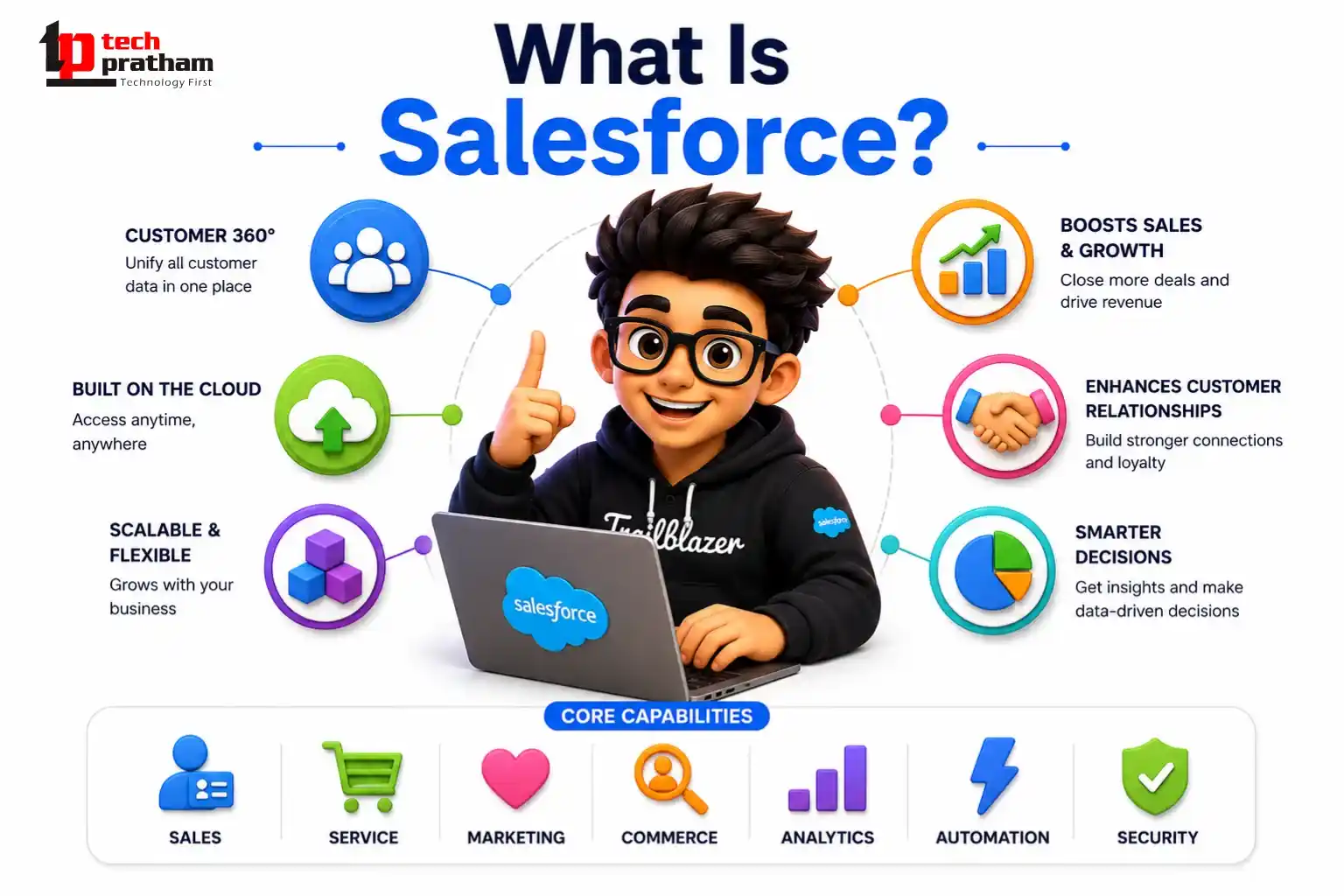
Salesforce is the world's leading cloud-based Customer Relationship Management (CRM) platform. It helps businesses manage customer information, sales processes, marketing campaigns, customer support, and business operations from a single platform.
Unlike traditional software that requires installation on local computers, Salesforce runs entirely on the cloud. Users can access it anytime and from anywhere using a web browser or mobile application, making it an ideal solution for businesses with remote or distributed teams. Salesforce was founded in 1999 with the vision of delivering software as a service (SaaS). Today, millions of users worldwide trust Salesforce to improve customer engagement and business efficiency.
Simply put, Salesforce enables organizations to:
- Store customer information securely
- Track leads and sales opportunities
- Automate repetitive business tasks
- Improve customer support
- Generate business reports
- Enhance collaboration across teams
- Make data-driven decisions
Because of its flexibility and scalability, Salesforce is used by businesses of all sizes across industries such as healthcare, banking, retail, manufacturing, education, and telecommunications.
What Is CRM?
CRM stands for Customer Relationship Management. It refers to the strategies, processes, and technologies businesses use to manage interactions with customers throughout their journey. Instead of storing customer details in spreadsheets or disconnected systems, a CRM platform keeps all customer-related information in one centralized location.
A CRM helps businesses:
- Capture customer inquiries
- Manage sales pipelines
- Monitor customer interactions
- Track service requests
- Improve customer satisfaction
- Increase sales and revenue
Salesforce is considered one of the most advanced CRM platforms because it combines sales, marketing, customer service, analytics, automation, and artificial intelligence into a single cloud-based solution.
How Does Salesforce Work?
Salesforce collects and organizes customer data in a centralized cloud database. Every interaction, whether it's a phone call, email, website inquiry, or purchase, is stored within the system. Different teams can access the same customer information based on their roles, ensuring better communication and faster decision-making.
For example:
- The sales team can track potential customers and manage opportunities.
- The marketing team can create targeted campaigns using customer insights.
- Customer support teams can resolve issues more quickly by viewing complete customer histories.
- Managers can monitor team performance through dashboards and reports.
Salesforce also automates many routine tasks, reducing manual work and allowing employees to focus on more strategic activities.
Key Components of Salesforce
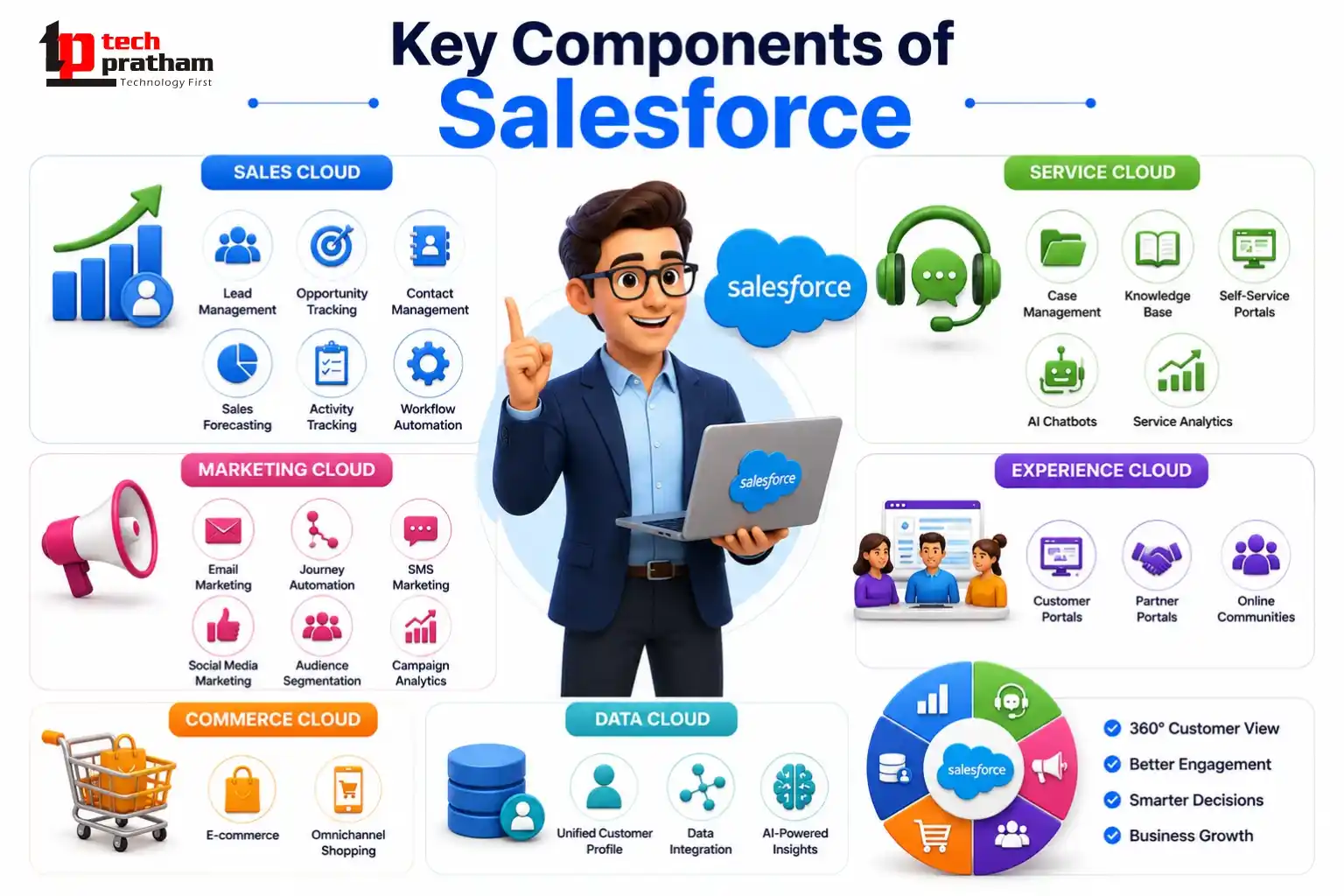
Salesforce is more than just a CRM platform—it's a complete suite of cloud-based applications designed to help businesses manage different aspects of their operations. Each Salesforce Cloud serves a specific purpose, enabling organizations to improve sales, customer service, marketing, commerce, and data management. By choosing the right combination of cloud solutions, businesses can streamline processes, enhance customer experiences, and drive growth more efficiently.
Salesforce offers multiple cloud solutions, each designed to address specific business needs.
Sales Cloud
Sales Cloud is one of the most widely used Salesforce products, designed to help sales teams manage the entire sales cycle—from capturing leads to closing deals. It centralizes customer information, automates repetitive tasks, and provides real-time insights into sales performance. With Sales Cloud, businesses can improve team productivity, strengthen customer relationships, and increase revenue through a more organized and efficient sales process.
Common features include:
- Lead management
- Opportunity tracking
- Account and contact management
- Sales forecasting
- Activity tracking
- Workflow automation
- Reports and dashboards
- Pipeline management
Service Cloud
Service Cloud is a customer service platform that enables businesses to deliver fast, personalized, and consistent support across multiple channels. It helps service teams manage customer inquiries, resolve issues efficiently, and improve customer satisfaction. By providing a complete view of customer interactions, Service Cloud allows support agents to offer better and more informed assistance.
It includes features such as:
- Case management
- Knowledge base
- Customer self-service portals
- AI-powered chatbots
- Service analytics
- Omnichannel support
- Field service management
- Service automation
Marketing Cloud
Marketing Cloud helps businesses create personalized and data-driven marketing campaigns that engage customers at every stage of their journey. It enables marketers to connect with audiences through email, mobile, social media, and digital advertising while tracking campaign performance in real time. With advanced automation and analytics, businesses can deliver the right message to the right customer at the right time.
Key capabilities include:
- Email marketing
- Customer journey automation
- SMS marketing
- Social media marketing
- Audience segmentation
- Campaign analytics
- Marketing automation
- Personalized customer engagement
Experience Cloud
Experience Cloud enables organizations to build secure digital experiences for customers, partners, and employees. Businesses can create branded customer portals, partner communities, employee hubs, and self-service websites that encourage collaboration and improve communication. It helps strengthen relationships while providing users with easy access to relevant information and resources.
Common use cases include:
- Customer communities
- Partner portals
- Employee portals
- Self-service websites
- Knowledge sharing
- Secure collaboration
Commerce Cloud
Commerce Cloud is Salesforce's e-commerce solution that helps businesses deliver seamless online shopping experiences across websites, mobile apps, and social commerce platforms. It supports personalized product recommendations, secure payments, inventory management, and order processing, enabling businesses to improve customer satisfaction and increase online sales.
Key features include:
- Online store management
- Personalized shopping experiences
- Product catalog management
- Inventory tracking
- Order management
- Secure payment integration
- Mobile commerce support
Data Cloud
Data Cloud helps organizations unify customer data collected from multiple sources into a single, comprehensive customer profile. This centralized data enables businesses to gain valuable insights, improve decision-making, and deliver highly personalized customer experiences. Combined with Salesforce AI capabilities, Data Cloud allows organizations to predict customer behavior, optimize marketing campaigns, and make smarter business decisions.
Key capabilities include:
- Customer data unification
- Real-time data integration
- AI-powered insights
- Customer segmentation
- Predictive analytics
- Data governance
- Personalized experiences
- Advanced reporting and analytics
Key Features of Salesforce
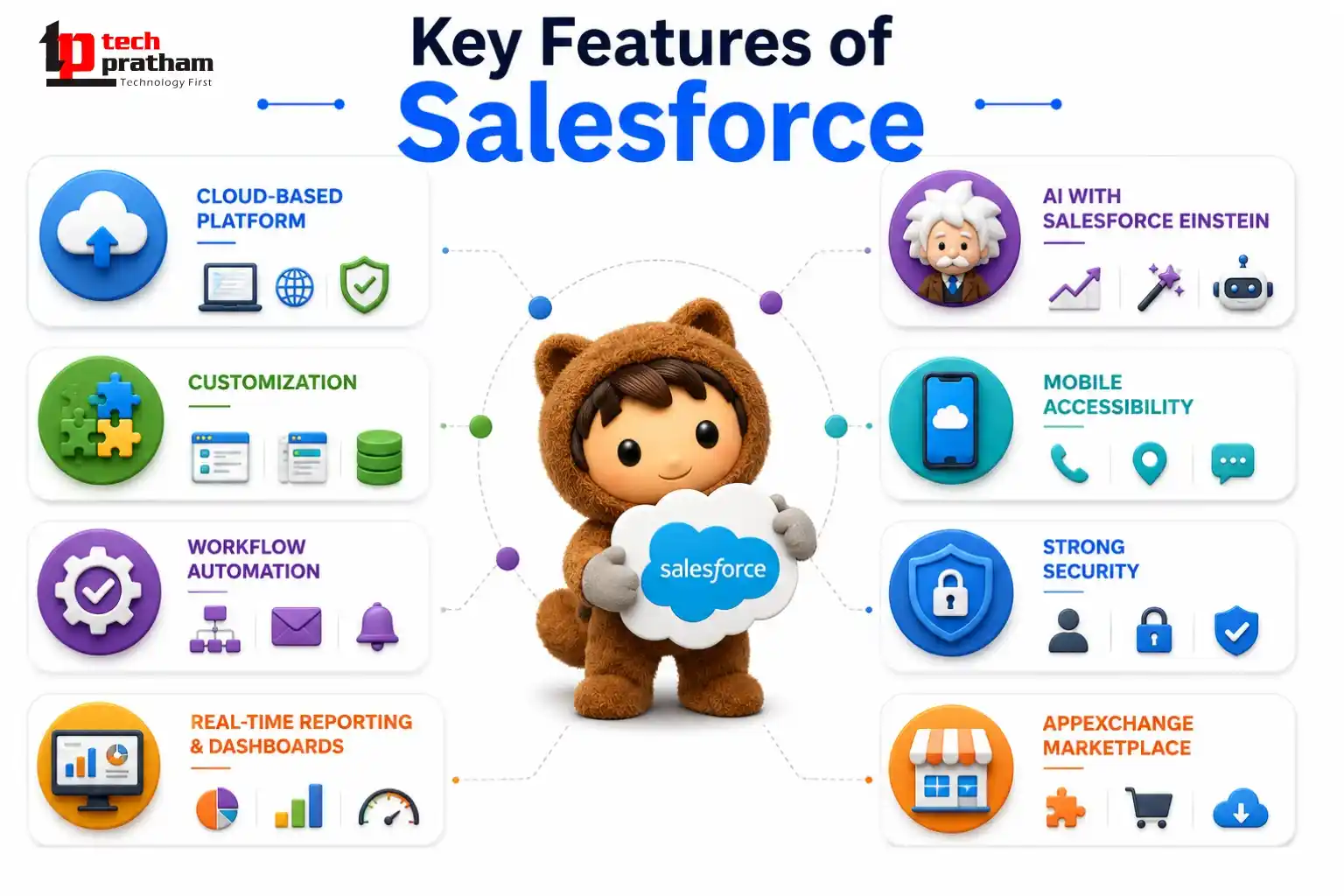
Salesforce is packed with powerful features that help businesses manage customer relationships, automate daily operations, and improve overall productivity. Its cloud-based architecture, advanced automation tools, and AI-powered capabilities make it one of the most trusted CRM platforms for organizations of all sizes. Whether you're a small business or a global enterprise, Salesforce provides the flexibility and tools needed to streamline business processes and deliver exceptional customer experiences.
Cloud-Based Platform
Salesforce is a cloud-based CRM platform, which means users can securely access customer data and business applications from anywhere using an internet connection. There's no need to install software on individual computers, making deployment, updates, and maintenance much simpler. This flexibility also supports remote work and improves team collaboration.
Customization
Every organization has unique business processes, and Salesforce offers extensive customization options to meet those needs. Businesses can create custom objects, fields, page layouts, workflows, reports, and dashboards without changing the core platform. This allows organizations to tailor Salesforce to their specific requirements and improve operational efficiency.
Workflow Automation
Salesforce automates repetitive and time-consuming tasks, helping employees focus on higher-value activities. Businesses can automate processes such as lead assignments, approval requests, follow-up emails, task creation, and notifications. Workflow automation not only saves time but also reduces manual errors and improves productivity.
Real-Time Reporting and Dashboards
Salesforce provides powerful reporting and dashboard tools that enable businesses to monitor key performance indicators in real time. Managers can analyze sales performance, customer interactions, marketing campaigns, and service metrics through interactive dashboards, helping them make faster and more informed business decisions.
Artificial Intelligence with Salesforce Einstein
Salesforce Einstein is the platform's built-in Artificial Intelligence (AI) solution that helps businesses make smarter decisions. It analyzes customer data, predicts trends, recommends the next best actions, automates routine tasks, and provides valuable insights that improve sales, marketing, and customer service performance.
Mobile Accessibility
Salesforce Einstein is the platform's built-in Artificial Intelligence (AI) solution that helps businesses make smarter decisions. It analyzes customer data, predicts trends, recommends the next best actions, automates routine tasks, and provides valuable insights that improve sales, marketing, and customer service performance.
Why Is Salesforce So Popular?
Salesforce has become the world's leading CRM platform because it combines innovation, flexibility, and ease of use in a single cloud-based solution. Businesses of all sizes trust Salesforce to manage customer relationships, automate processes, and improve productivity. Its continuous updates, strong ecosystem, and growing demand across industries have made it one of the most widely adopted business platforms globally.
Some of the key reasons behind Salesforce's popularity include:.
- Easy-to-use and user-friendly interface
- Cloud-based platform with anytime, anywhere access
- Highly scalable for businesses of all sizes
- Regular updates with the latest features and innovations
- AI-powered capabilities through Salesforce Einstein
- Powerful workflow automation and productivity tools
- Real-time reporting and interactive dashboards
- Easy integration with third-party applications
- Thousands of apps available on AppExchange
- Strong data security and compliance features
- Trusted by startups, SMEs, and Fortune 500 companies
- Widely used across healthcare, finance, retail, manufacturing, education, telecom, and other industries
- Large global community with Trailhead, user groups, and developer resources
- Multiple certification and learning opportunities
Why Is Salesforce Important for Your Career?
Technology is transforming every industry, and businesses are investing more in digital platforms that help them manage customers efficiently. Salesforce has become one of the most valuable business technologies because it combines customer relationship management, automation, artificial intelligence, analytics, and cloud computing into a single platform.
Learning Salesforce is not just about mastering a software application—it is about developing a skill that is in demand across the world. Whether you want to start your career or move into a better-paying role, Salesforce offers excellent opportunities for long-term professional growth.
Top Reasons to Learn Salesforce
Salesforce has become one of the most in-demand skills in the technology industry, offering excellent career opportunities for both freshers and experienced professionals. As businesses continue to adopt cloud-based CRM solutions, the need for skilled Salesforce experts is growing rapidly. Whether you're looking for a career switch, higher salary, or long-term job stability, learning Salesforce can be a valuable investment.
1. High Demand Across Industries
Organizations of all sizes use Salesforce to manage customer relationships, sales, marketing, and business operations. As digital transformation accelerates, the demand for Salesforce professionals continues to rise across multiple sectors.
Industries hiring Salesforce professionals include:
- Information Technology (IT)
- Banking and Financial Services (BFSI)
- Healthcare
- Manufacturing
- Retail
- E-commerce
- Telecommunications
- Education
- Insurance
- Consulting
This broad industry adoption gives professionals the flexibility to explore diverse career opportunities instead of being limited to a single domain.
2. Excellent Salary Potential
One of the biggest advantages of learning Salesforce is the opportunity to earn competitive salaries. Compensation depends on factors such as experience, certifications, technical skills, and job role, but Salesforce professionals are among the highest-paid CRM experts.
Average Salesforce Salary in India
Experience | Estimated Salary |
Freshers (0–2 Years) | ₹4–8 LPA |
Mid-Level (2–5 Years) | ₹8–15 LPA |
Senior Professionals | ₹15–30+ LPA |
Professionals with Salesforce certifications, practical project experience, and specialized skills often receive even higher salary packages.
3. Global Career Opportunities
Salesforce is used by businesses in more than 150 countries, making it a globally recognized technology platform. Skilled Salesforce professionals can explore job opportunities in India as well as international markets.
Popular countries hiring Salesforce professionals include:
- United States
- Canada
- United Kingdom
- Australia
- Germany
- Singapore
- United Arab Emirates (UAE)
Many multinational companies actively recruit certified Salesforce professionals for global projects and remote roles.
4. No Mandatory Coding for Beginners
Many people believe that learning Salesforce requires strong programming skills, but that's not true. Several Salesforce career paths focus on platform configuration, business processes, and automation rather than coding.
Popular non-coding Salesforce roles include:
- Salesforce Administrator
- Salesforce Business Analyst
- Salesforce Consultant
- Salesforce Functional Consultant
If you're interested in development, you can later expand your skills and become a Salesforce Developer or Salesforce Architect by learning Apex, Lightning Web Components (LWC), and integrations.
5. Continuous Learning and Career Growth
Salesforce regularly introduces new technologies and platform updates, creating continuous opportunities for professionals to enhance their skills. Innovations such as Salesforce Einstein, Data Cloud, Agentforce, automation, and industry-specific cloud solutions ensure that Salesforce remains one of the most future-ready career choices in the IT industry.
Who Should Learn Salesforce?
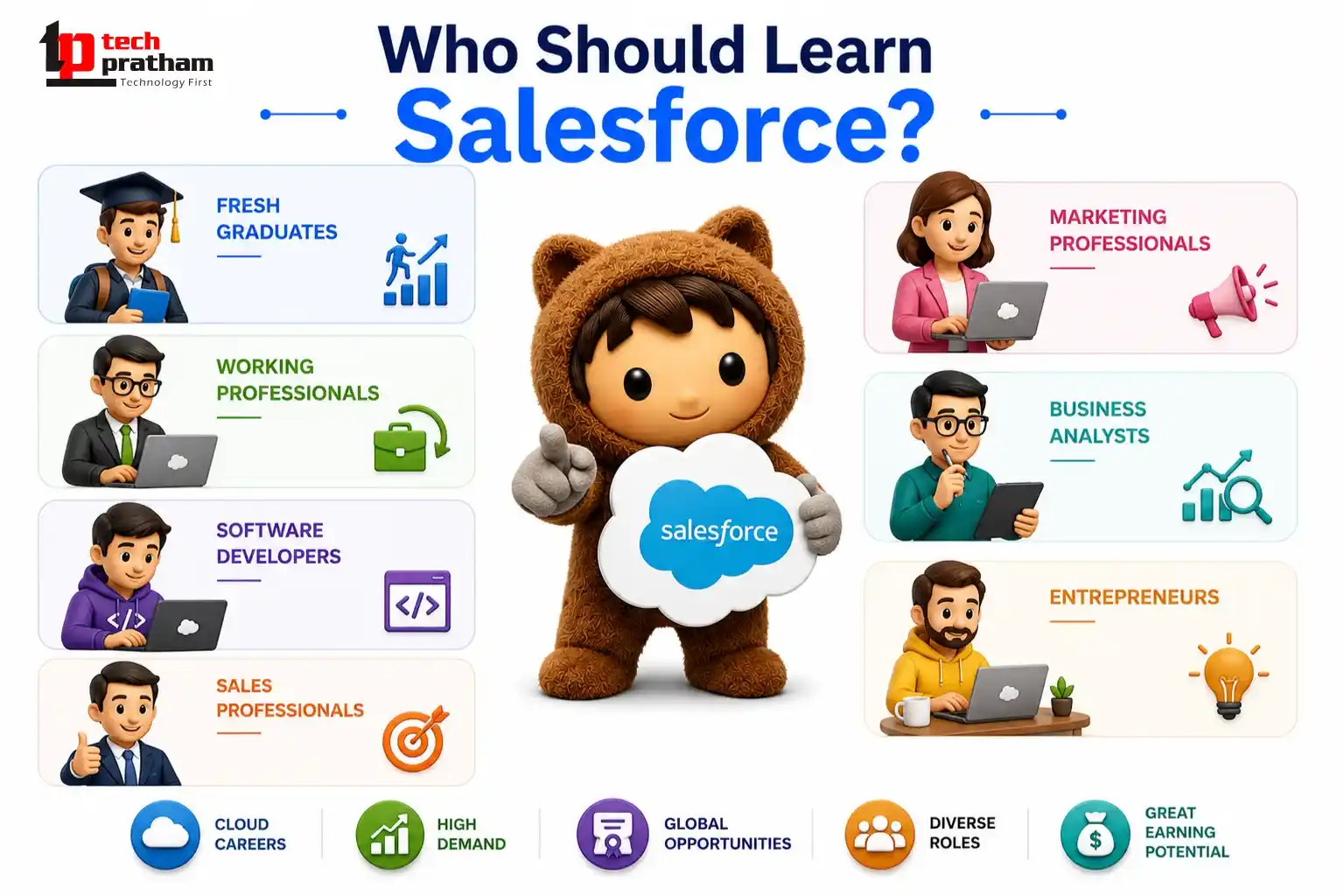
Salesforce is a versatile platform that can be learned by individuals from a wide range of educational and professional backgrounds. Whether you're just starting your career, looking to switch to the IT industry, or aiming to enhance your existing skills, Salesforce offers opportunities for everyone. Fresh graduates can build a strong foundation in cloud technology through certifications and hands-on training, while working professionals can transition into high-demand Salesforce roles without needing extensive programming experience.
Software developers can expand their expertise by learning technologies such as Apex, Salesforce Lightning Web Components (LWC), and Salesforce integrations to build custom applications. Sales professionals can improve their knowledge of customer relationship management, lead tracking, and sales automation, while marketing professionals can leverage Salesforce Marketing Cloud to create personalized campaigns and automate customer journeys.
Popular Salesforce Certifications
Salesforce offers a wide range of certifications for beginners, administrators, developers, consultants, business analysts, and AI professionals. These certifications validate your knowledge, enhance your credibility, and improve your chances of landing high-paying Salesforce jobs.
Some of the most popular Salesforce certifications include:
- Salesforce Certified Associate
- Salesforce Certified Administrator
- Salesforce Platform App Builder
- Salesforce Platform Developer I
- Salesforce JavaScript Developer I
- Salesforce AI Associate
- Salesforce Business Analyst
- Salesforce Advanced Administrator
- Salesforce Sales Cloud Consultant
- Salesforce Service Cloud Consultant
Career Opportunities After Learning Salesforce
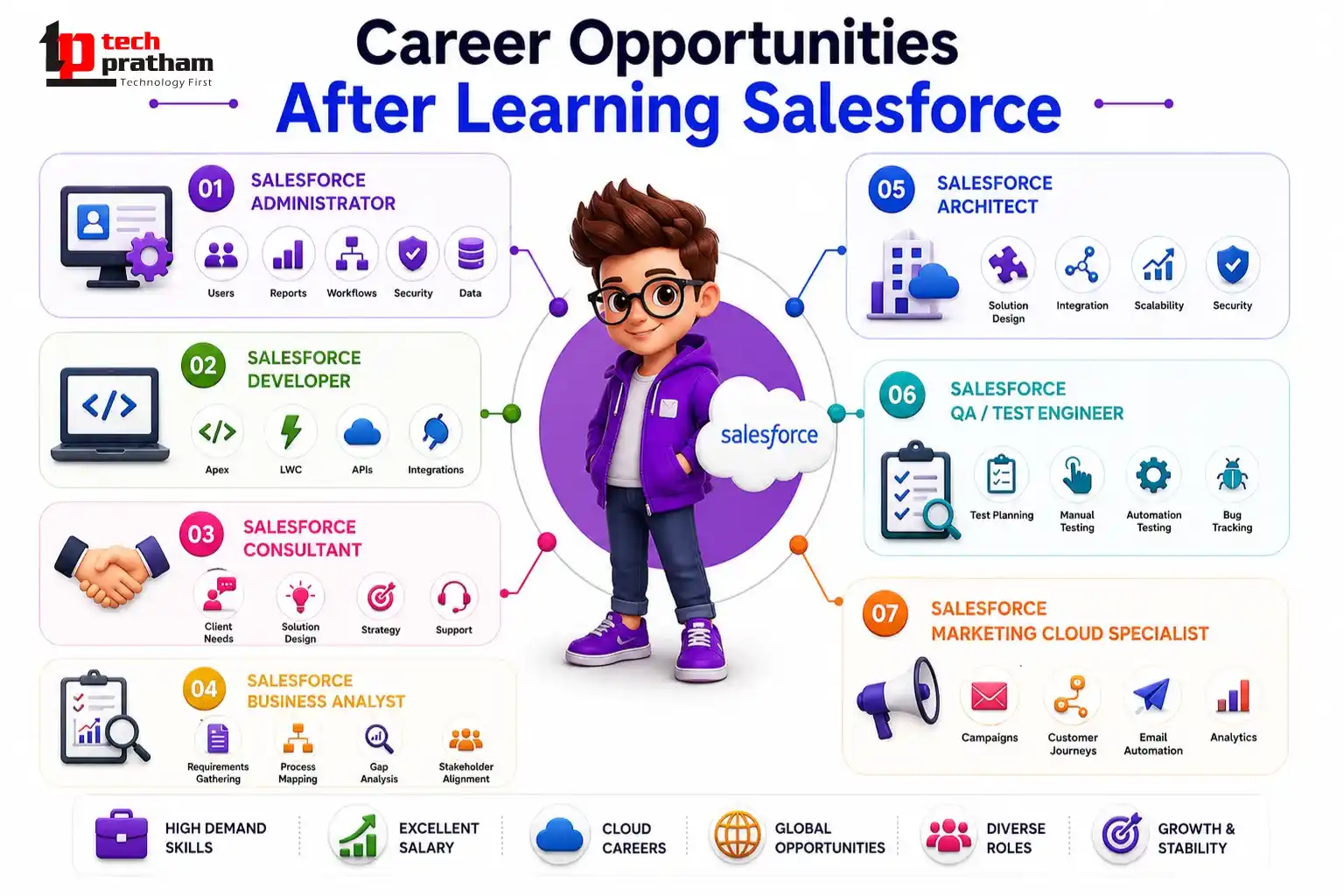
The Salesforce ecosystem offers a wide range of career opportunities for both technical and non-technical professionals. Whether you're a fresher, an experienced IT professional, or someone looking to switch careers, Salesforce provides multiple job roles based on your skills and interests. With businesses across industries adopting Salesforce, the demand for certified professionals continues to grow in India and globally.
Some of the most popular career paths include Salesforce Administrator, Salesforce Developer, Salesforce Consultant, Salesforce Business Analyst, Salesforce Architect, Salesforce QA/Test Engineer, and Salesforce Marketing Cloud Specialist. These roles involve managing Salesforce platforms, developing custom applications, implementing CRM solutions, analyzing business requirements, testing applications, and creating personalized marketing campaigns.
Top Companies Hiring Salesforce Professionals
Salesforce professionals are in high demand across a wide range of industries, including information technology, banking, healthcare, retail, manufacturing, telecommunications, insurance, and e-commerce. As organizations increasingly adopt Salesforce to manage customer relationships, automate business processes, and drive digital transformation, the need for skilled Salesforce talent continues to grow. Companies are actively looking for professionals with expertise in Salesforce Administration, Development, Consulting, Business Analysis, Marketing Cloud, and Architecture.
Some of the leading companies hiring Salesforce professionals include Salesforce, Accenture, Deloitte, Tata Consultancy Services (TCS), Infosys, Wipro, Cognizant, Capgemini, HCLTech, Tech Mahindra, IBM, PwC, EY, KPMG, LTIMindtree, Genpact, Oracle, Amazon, DXC Technology, Persistent Systems, Hexaware Technologies, Mphasis, Birlasoft, NTT DATA, and Publicis Sapient. In addition to these global enterprises, many startups, CRM consulting firms, and Salesforce implementation partners also offer exciting career opportunities.
Future Scope of Salesforce in 2026 and Beyond
Salesforce continues to lead the global CRM market by introducing innovative technologies such as Artificial Intelligence (AI), automation, analytics, and cloud computing. As businesses increasingly adopt digital solutions to improve customer engagement, the demand for Salesforce professionals is expected to remain strong in the coming years.
In 2026 and beyond, technologies like Salesforce Einstein, Data Cloud, Agentforce, and industry-specific cloud solutions are reshaping how organizations interact with customers and make business decisions. Companies are looking for professionals who can configure, customize, and optimize these technologies to drive business growth.
Tips to Start Your Salesforce Career
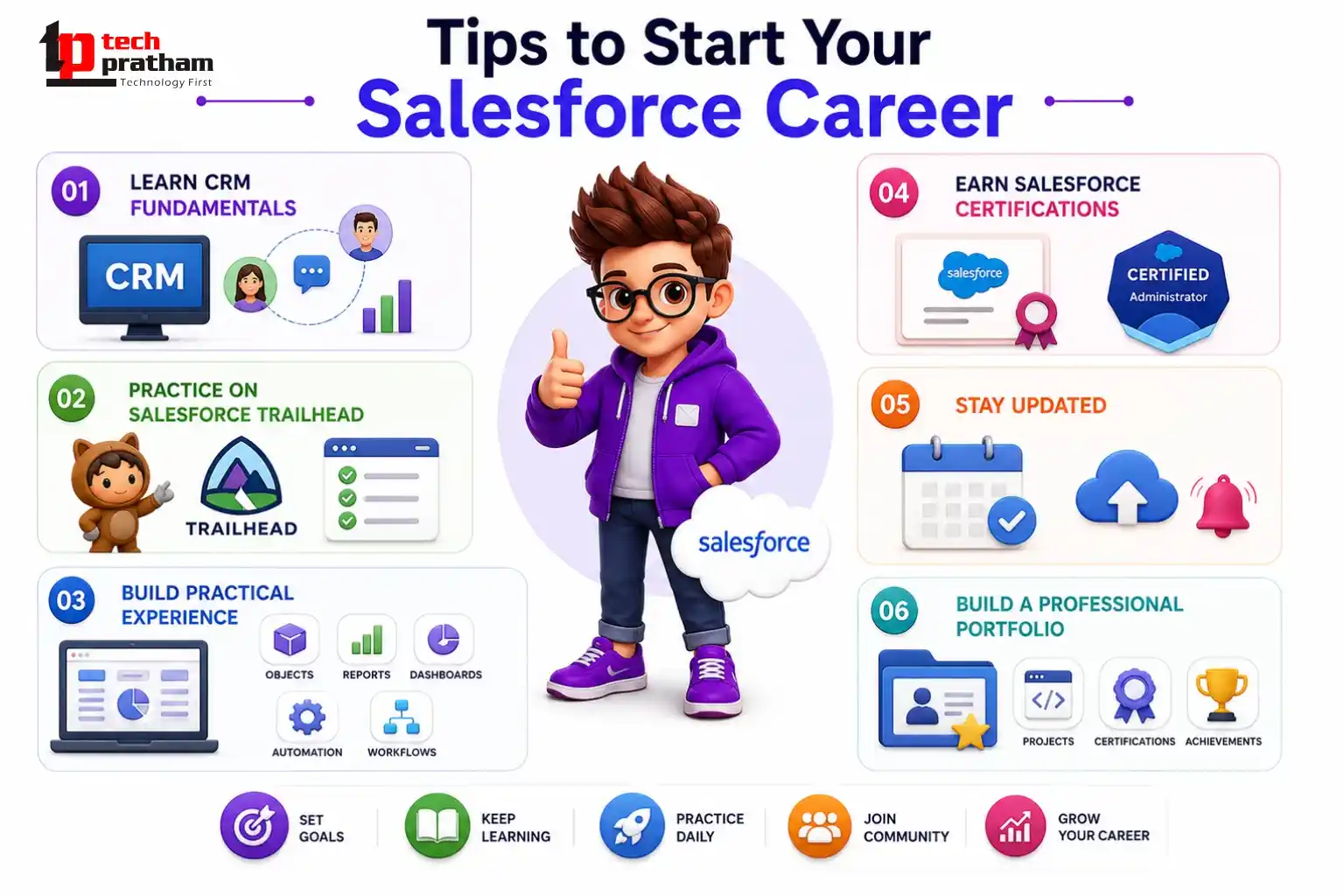
Starting a career in Salesforce is easier when you follow a structured learning path and gain practical experience. Begin by understanding the fundamentals of Customer Relationship Management (CRM) and how Salesforce helps businesses manage customer relationships. Strengthen your skills by practicing on Salesforce Trailhead, the official learning platform that offers free modules, hands-on challenges, and guided learning paths. As you progress, work on real-world projects to gain experience with objects, reports, dashboards, automation, and workflows.
Frequently Asked Questions (FAQs)
1. What is Salesforce?
2. Why is Salesforce important for a career?
3. Who can join Salesforce Training in India?
8. What skills will I learn in Salesforce Online Training in India?
Conclusion
Salesforce has become much more than a CRM platform. It is a complete business ecosystem that helps organizations improve customer relationships, automate operations, and make data-driven decisions. As companies across industries continue to adopt Salesforce, the demand for skilled professionals is growing steadily.
Whether you're a student, a recent graduate, a working professional, or someone planning a career change, learning Salesforce can open the door to exciting opportunities in cloud computing and digital transformation. From roles such as Salesforce Administrator and Developer to Consultant and Business Analyst, the platform offers diverse career paths with excellent growth potential.
Related Articles
Top 10 Salesforce Courses to Advance Your Career
Explore the top 10 Salesforce courses to build in-demand skills, earn certifications, and advance your career in the Salesforce ecosystem.

How Salesforce Developers Can Switch to a MuleSoft Career
Learn how Salesforce Developers can transition to MuleSoft, build integration skills, work with APIs, and explore new career opportunities.
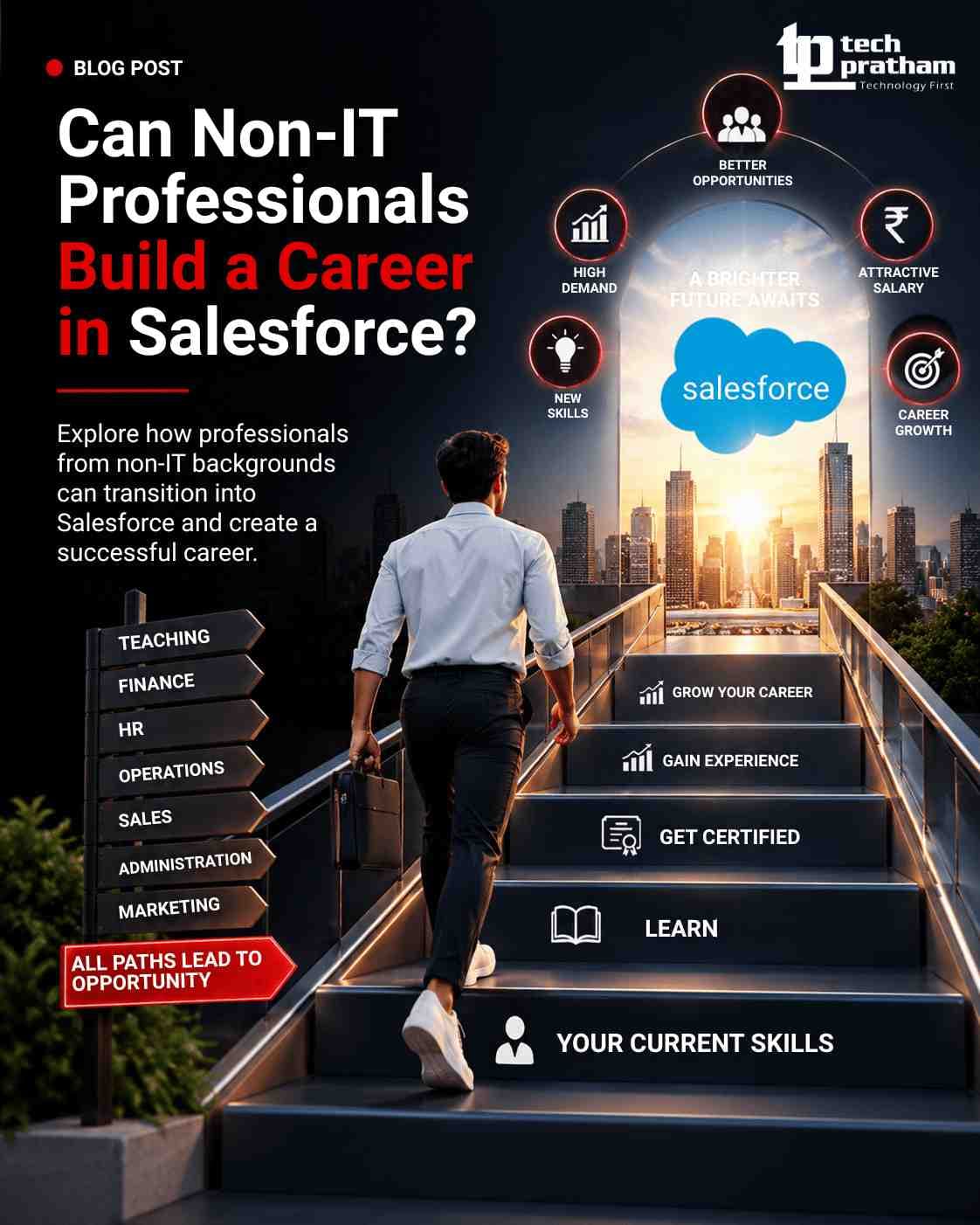
Can Non-IT Professionals Build a Career in Salesforce?
Can non-IT professionals build a career in Salesforce? Learn about Salesforce roles, coding requirements, AI impact, skills, certification, and career




 +91-8882178896
 +1 (343) 477-0926