
ServiceNow Developer Career Path 2026: Syllabus, Free Courses, and Certification Tips
Digital transformation is no longer optional. In 2026, companies will invest heavily in workflow automation, cloud platforms, and AI-driven service management. At the center of this transformation stands ServiceNow. As enterprises modernize IT operations, HR processes, security workflows, and customer service systems, the demand for skilled ServiceNow developers continues to rise.
If you want a stable, high-growth, and globally respected technology career, this complete guide explains everything you need to know — from syllabus and roadmap to certifications, salary, and job opportunities.
This guide is practical, structured, and written for beginners as well as professionals who want to switch careers.
What is ServiceNow Development and Why It’s In Demand in 2026?
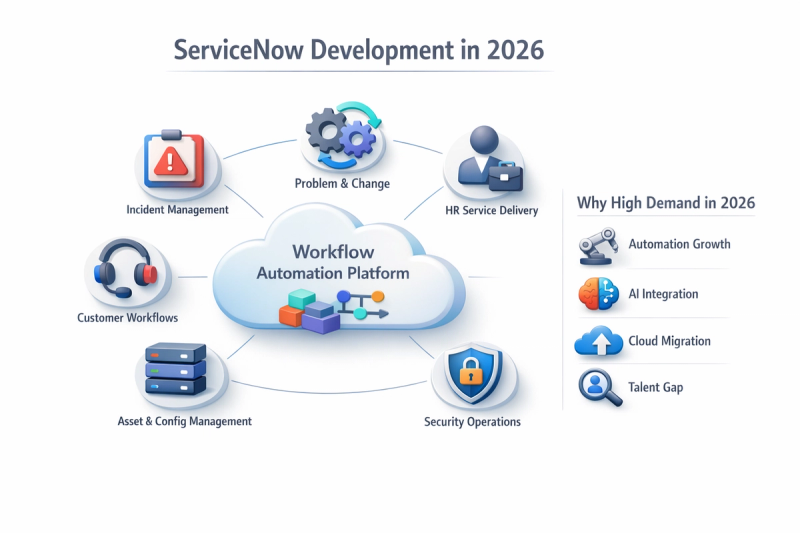
ServiceNow development involves designing, customizing, and automating business workflows on the ServiceNow cloud platform. A ServiceNow developer builds applications, writes scripts, configures modules, manages integrations, and improves enterprise processes using structured logic.
Organizations use ServiceNow to manage:
1. Incident management
2. Problem and change management
3. HR service delivery
4. Customer service workflows
5. Security operations
6. Asset and configuration management
In 2026, companies focus on automation, AI integration, operational efficiency, and cost reduction. ServiceNow supports these goals through low-code development tools, Flow Designer automation, predictive intelligence, and enterprise integrations.
The demand increases because:
1. Every large enterprise uses workflow automation
2. Companies migrate to cloud platforms
3. ServiceNow expands into new business domains
4. Skilled professionals remain limited compared to demand
This demand-supply gap makes ServiceNow development one of the most secure and high-paying technology careers.
Who Should Choose a ServiceNow Developer Career?
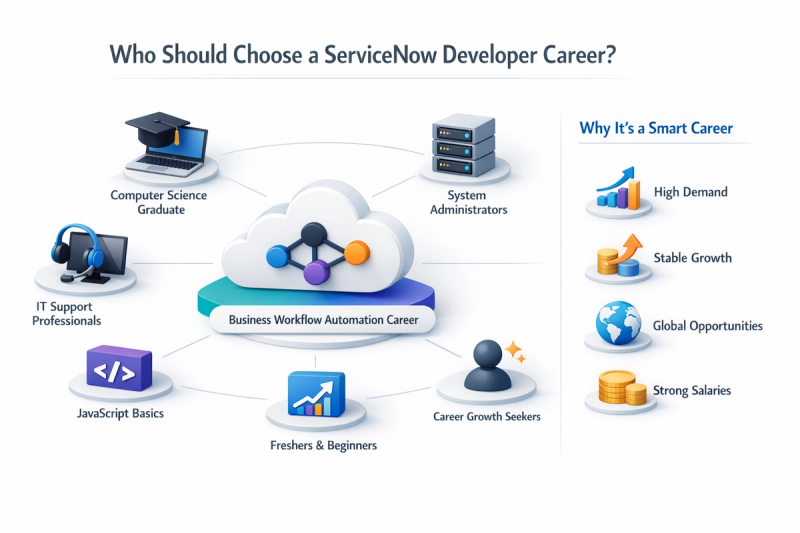
ServiceNow development suits individuals who enjoy solving business problems using structured logic and automation.
You should choose this career if:
1. You are a computer science or IT graduate
2. You work in IT support and want career growth
3. You are a system administrator
4. You know the basics of the JavaScripting language.
5. You want a specialized, high-demand technology skill
Even freshers can enter this field with proper training and certification. Unlike heavy programming roles, ServiceNow focuses more on business logic, workflow automation, and platform customization.
If you prefer stable career growth, global demand, and strong salary progression, ServiceNow development is an excellent choice.
ServiceNow Developer Career Roadmap (Step-by-Step Guide)
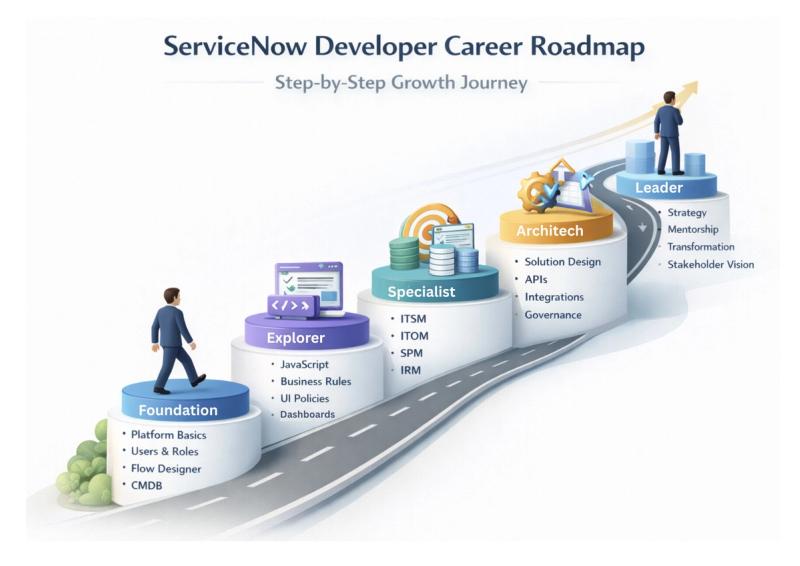
A successful ServiceNow career doesn’t happen overnight. It evolves step by step — from learning the platform basics to eventually guiding enterprise-level strategy. Each stage builds on the previous one, increasing both your technical depth and business impact.
Let’s explore the five major phases of ServiceNow career growth and understand how professionals typically progress.
Stage 1: Foundation — Mastering the Essentials
Every ServiceNow journey begins with understanding the platform’s core structure. This phase is all about building strong fundamentals that support everything you will learn later.
At this level, you focus on platform administration — managing users, roles, permissions, notifications, and security settings. You also learn how to automate workflows using Flow Designer and understand how the CMDB (Configuration Management Database) organizes and connects IT assets.
These skills may not seem flashy, but they are critical. A strong foundation ensures you can manage and maintain the system efficiently. Professionals who rush through this phase often struggle later, so taking time to truly understand the basics is essential.
Stage 2: Explorer — Customizing and Expanding
Once the fundamentals are clear, the next step is experimenting with customization. Here, you move beyond maintenance and begin enhancing the platform to match business needs.
This stage includes learning ServiceNow scripting using JavaScript, creating business rules and client scripts, and designing UI policies. You also build dashboards and reports that provide real-time insights for teams. Working with Service Portals and modern Workspaces helps improve user experience across departments.
At this point, you begin contributing meaningful improvements instead of just supporting existing configurations. Small enhancements can create noticeable value, helping you gain confidence and recognition within your organization.
Stage 3: Specialist — Developing Deep Expertise
After gaining hands-on experience, many professionals choose to specialize. ServiceNow offers several powerful modules, and deep expertise in one area significantly increases your market value.
Some popular specializations include:
1. ITSM (IT Service Management): Managing incidents, problems, changes, and service requests.
2. ITOM (IT Operations Management): Monitoring infrastructure and managing operational events.
3. SPM (Strategic Portfolio Management): Planning projects and aligning resources with business goals.
4. IRM (Integrated Risk Management): Handling risk, compliance, and governance workflows.
Specialists often lead module implementations and become go-to experts in their domain. Rather than spreading knowledge too broadly, focusing deeply on one or two areas helps establish long-term career stability and higher earning potential.
Stage 4: Architect — Designing Enterprise Solutions
With years of experience and specialization, the next step is architecture. At this level, your role shifts from building features to designing large-scale solutions.
Architects create scalable platform designs, manage advanced workflows across multiple departments, and oversee complex integrations with other enterprise systems through APIs and cloud technologies. They also define governance standards and ensure the platform remains stable, secure, and aligned with best practices.
Beyond technical expertise, architects influence decision-making at a strategic level. They collaborate with IT, HR, finance, and leadership teams to ensure ServiceNow supports broader organizational goals.
Stage 5: Leader — Driving Strategy and Transformation
The final stage moves beyond technology into leadership and vision. ServiceNow leaders guide enterprise strategy, mentor teams, and influence long-term digital transformation initiatives.
In this role, professionals conduct workshops, engage stakeholders, shape platform roadmaps, and ensure successful adoption across departments. They nurture upcoming talent and help build strong internal teams.
Leaders are not just technical experts — they are trusted advisors who connect business objectives with technology solutions. Their impact extends beyond projects and into organizational growth.
ServiceNow Developer Syllabus 2026 (Beginner to Advanced)
A strong syllabus should cover platform fundamentals, scripting, automation, and integration.
Beginner Level
At the beginner level, you learn the basics of the ServiceNow platform and how it works as a Cloud-based SaaS solution. You understand cloud computing fundamentals and core ITIL concepts like incident and change management. The training covers Tables and database structure, Forms and lists, and how data is managed. You also gain hands-on experience with basic configuration, including creating fields, customizing forms, and making simple system changes.
Intermediate Level
At the intermediate level, you deepen your understanding of ServiceNow by working with Business Rules to automate server-side logic and Client Scripts to control form behavior on the client side. You learn to create UI Actions to add custom buttons and links for better user interaction. Access Control Lists (ACLs) help you manage data security and define user permissions. You also work with Import Sets and Transform Maps to migrate external data into ServiceNow, and use Data Policies to maintain data integrity and enforce validation rules.
Advanced Level
At the advanced level, you master powerful tools like Flow Designer to automate complex workflows and App Engine Studio to build custom applications quickly. You work with Scoped applications to develop secure, modular solutions. You gain hands-on experience in REST and SOAP integrations to connect ServiceNow with external systems. The training also covers performance optimization techniques, effective debugging and troubleshooting methods, and implementing security best practices to ensure scalable, secure, and high-performing applications.
Skills Required to Become a ServiceNow Developer
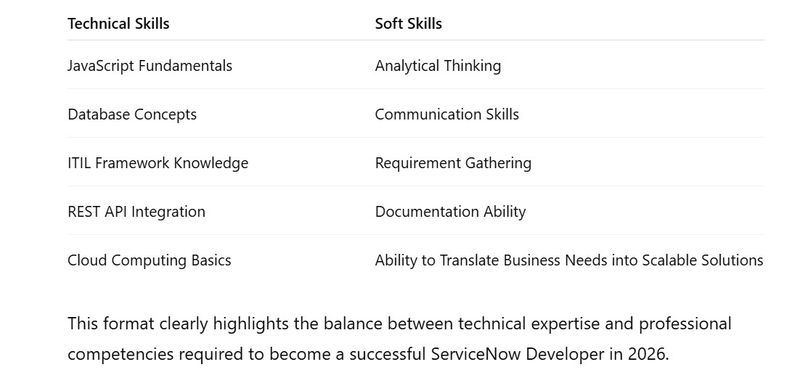
To succeed in 2026, you must combine technical expertise with professional skills.
Best Free ServiceNow Courses for Beginners
You can start learning ServiceNow without financial investment.
Free learning options include:
1. ServiceNow documentation
3. Structured online tutorials
4. You can learn from Techpratham Youtube channel.
Always choose resources that include hands-on practice. Theory alone will not prepare you for real projects.
Free courses help you build confidence before investing in advanced certification programs.
ServiceNow Developer Certifications Explained
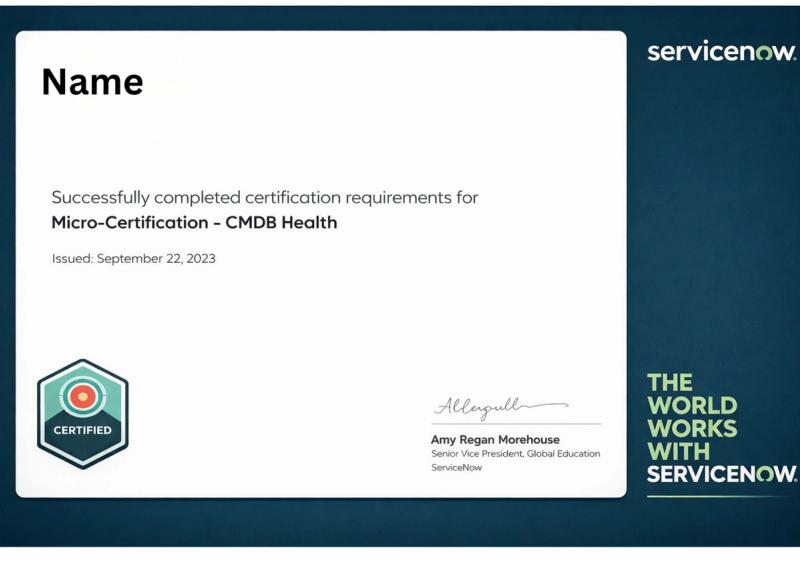
Certifications validate your expertise and increase your credibility in the job market.
1. Entry-Level Certification
Certified System Administrator (CSA)The CSA certification is the foundation for anyone starting a ServiceNow career. It validates your understanding of the platform basics, including navigation, user interface, tables, forms, reports, and basic configuration. This certification proves you can manage and maintain a ServiceNow instance effectively.
2. Developer Certification
Certified Application Developer (CAD) The CAD certification is designed for developers who build custom applications on ServiceNow. It validates your skills in scripting, business rules, client scripts, Flow Designer, and application development using scoped apps. This certification confirms your ability to design and develop scalable solutions.
3. Specialist Certifications
a. ITSM Implementation Specialist This certification focuses on implementing IT Service Management processes such as incident, problem, and change management. It validates your expertise in configuring ITSM modules according to best practices.
b. HR Service Delivery Specialist This certification demonstrates your ability to configure and manage HR workflows, employee lifecycle processes, and HR case management within ServiceNow.
c. Customer Service Management Specialist This certification validates your knowledge in implementing customer service workflows, case management, and service automation to improve customer experience.
Certification improves job opportunities, salary potential, and recruiter trust.
How to Prepare for ServiceNow Certification (Study Plan)
Follow a structured study plan for better results.
Weeks 1–2: Learn Platform Fundamentals
Start by understanding the core architecture of ServiceNow, including navigation, tables, forms, lists, users, roles, and basic configuration. Focus on ITIL concepts and how modules like Incident and Change Management work. Spend time exploring your developer instance daily to build a strong foundation.
Weeks 3–4: Practice Scripting and Automation
Begin working on Business Rules, Client Scripts, UI Policies, and Flow Designer. Learn how automation works on both client and server sides. Practice writing simple scripts and understand when to use each feature. Hands-on exercises will improve your logical thinking and coding confidence.
Week 5: Build Two Real-Time Projects
Create small but practical projects such as an Incident Automation System or Employee Onboarding Application. This helps you apply your knowledge in real-world scenarios and strengthens problem-solving skills.
Week 6: Take Mock Tests and Revise Weak Areas
Attempt certification-style mock exams to assess your readiness. Identify weak topics and revise them thoroughly. Focus on scenario-based questions instead of memorizing answers.
Focus on daily hands-on practice using a developer instance. Solve scenario-based questions instead of memorizing answers.
ServiceNow Developer Salary in 2026 (India & Global)
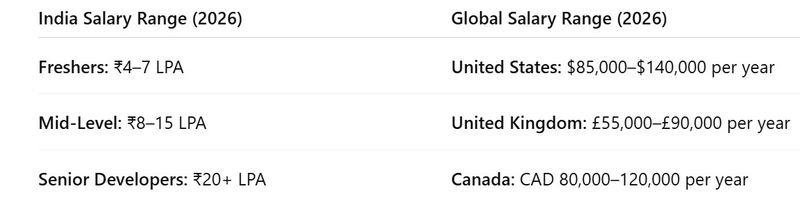
This comparison shows the strong earning potential of ServiceNow Developers both in India and internationally, driven by high global demand.
ServiceNow Developer Job Opportunities & Companies Hiring
ServiceNow developers find opportunities in:
- IT services companies(Tata Consultancy Services and Infosys)
- Consulting firms (Accenture and Deloitte)
- Banking and finance organizations (ICICI Bank and HDFC Bank)
- Healthcare enterprises (Fortis Healthcare and Apollo Hospitals)
- Telecom companies (Bharti Airtel and Reliance Jio)
- Manufacturing industries (Tata Motors and Siemens)
with major hiring hubs in Gurgaon (Cyber City, Udyog Vihar), Bangalore (Whitefield, Electronic City), Hyderabad (HITEC City), Pune (Hinjewadi), and Noida (Sector 62), while remote international roles continue expanding across global markets.
Conclusion:
ServiceNow development is a high-demand, future-proof career in 2026. With the right skills, structured learning, hands-on practice, and certification, you can secure strong job opportunities and competitive salaries in India and globally.
If you stay consistent and focus on real-world projects, ServiceNow can offer long-term growth and stability in the tech industry.
FAQs About ServiceNow Developer
Q1. How to Get Your First ServiceNow Developer Job
To get your first ServiceNow Developer job, start by learning platform fundamentals, JavaScript, and ITIL concepts. Practice daily using a developer instance and build 1–2 real-time projects to showcase your skills. Earn certifications like CSA to boost credibility. Optimize your resume and LinkedIn profile with relevant keywords, apply for entry-level roles, and prepare for scenario-based interview questions. Consistent hands-on practice and certification increase your chances of getting hired.
Q2. Is ServiceNow a Good Career Choice in 2026?
Yes, ServiceNow is a strong career choice in 2026 due to high global demand, excellent salary growth, and long-term job stability. As companies adopt automation and AI-driven workflows, ServiceNow professionals remain essential across industries. Its continuous expansion ensures steady job opportunities and career growth, making it a future-proof technology career option.
Q3. Can non-IT professionals switch to a ServiceNow Developer role in 2026?
Yes. Professionals from support, testing, HR tech, or operations can transition by learning platform fundamentals, ITIL basics, and JavaScript. Start with CSA certification, build 1–2 workflow automation projects, and gain hands-on practice in a developer instance. Domain knowledge often becomes an advantage during implementation projects.
Q4. What skills differentiate a fresher from an experienced ServiceNow developer?
Freshers focus on configuration, basic scripting, and platform navigation. Experienced developers master integrations (REST/SOAP), performance tuning, scoped apps, security, and architecture design. They also understand business requirements, stakeholder communication, and scalable solution design across enterprise environments.
Q5. How long does it take to become job-ready in ServiceNow?
With consistent daily practice, most beginners become job-ready in 3–6 months. The timeline depends on prior IT knowledge, JavaScript basics, and hands-on project experience. Completing CSA certification and building real-time workflow projects significantly improves interview readiness and hiring chances.