

ServiceNow Developer Deep Dive: From Core Scripting to Advanced Application Development
Table of Contents
ServiceNow isn’t just a ticketing tool anymore—it’s a full-scale enterprise application development platform powering digital workflows for some of the world’s largest organizations. As businesses accelerate automation, integration, and AI-driven operations, the role of a ServiceNow Developer has evolved from writing simple scripts to designing scalable, secure, and high-performance applications. Whether you’re customizing core ITSM processes or building enterprise-grade solutions from scratch, mastering ServiceNow development has become a high-value skill in today’s cloud-first ecosystem.
This deep-dive guide takes you through the complete ServiceNow developer journey, starting with core scripting fundamentals like JavaScript, Business Rules, and Glide APIs, and progressing into advanced application development, integrations, automation, and performance optimization. Designed for both aspiring and experienced developers, this blog breaks down complex concepts into practical, real-world insights—helping you build robust applications, follow best practices, and stay future-ready in a platform that continues to redefine enterprise digital transformation.
What Does a ServiceNow Developer Do?
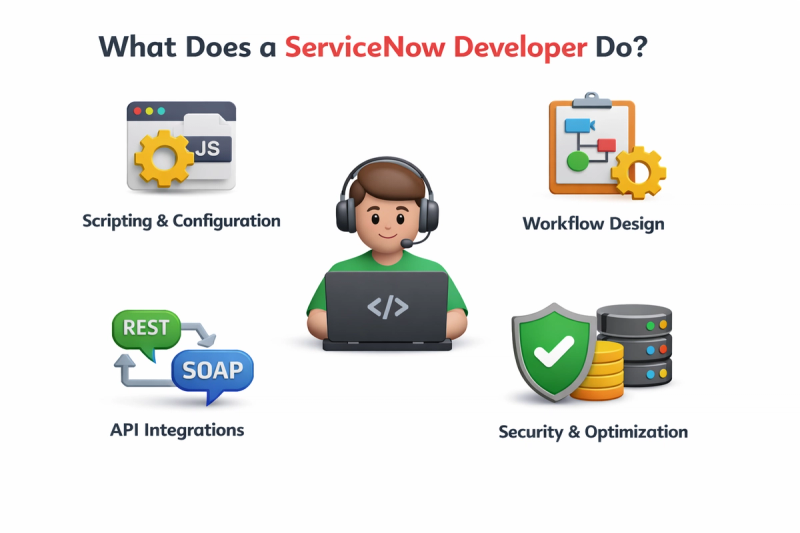
A ServiceNow Developer is responsible for designing, configuring, and building applications on the ServiceNow platform to automate business processes and improve operational efficiency. Their work goes far beyond basic ticket customization—they develop server-side and client-side scripts, create Business Rules, Script Includes, UI Policies, and workflows, and design custom applications using ServiceNow Studio. By translating business requirements into scalable technical solutions, ServiceNow Developers help organizations streamline IT service management, HR workflows, customer service operations, and other enterprise functions.
In addition to application development, ServiceNow Developers play a key role in platform optimization, integrations, and security. They integrate ServiceNow with external systems using REST and SOAP APIs, implement role-based access controls (RBAC), and ensure applications follow performance and secure coding best practices. Developers also collaborate closely with stakeholders, architects, and administrators to test, deploy, and maintain solutions across environments. As organizations increasingly rely on automation and AI-driven workflows, ServiceNow Developers are expected to build future-ready solutions that are reliable, efficient, and adaptable to evolving business needs.
ServiceNow Platform Architecture Explained The ServiceNow platform architecture is built on a cloud-based, multi-instance model that allows organizations to develop, customize, and scale applications without managing underlying infrastructure. At its core, ServiceNow runs on a single data model where all applications—such as IT Service Management (ITSM), HR Service Delivery, and Customer Service Management—share the same database and platform services. This unified architecture enables seamless data flow, consistent user experiences, and easier automation across departments, making ServiceNow a powerful enterprise workflow platform.
A key component of ServiceNow architecture is its three-tier structure, which includes the database layer, application layer, and user interface layer. The database layer stores records, tables, and relationships, including the CMDB, which acts as a central source of truth for configuration items. The application layer contains business logic such as Business Rules, Script Includes, workflows, and integrations that process data and enforce rules. The user interface layer delivers forms, lists, dashboards, and portals that allow users to interact with the platform through web and mobile experiences.
What makes the ServiceNow platform architecture especially developer-friendly is its metadata-driven and extensible design. Most configurations—tables, fields, forms, and scripts—are stored as metadata, allowing changes to be tracked, versioned, and promoted across environments. This approach supports rapid application development while maintaining stability and security. By understanding ServiceNow’s architecture, developers can build scalable, high-performing applications, troubleshoot issues effectively, and design solutions that align with best practices and long-term platform growth.
Core scripting fundamentals in ServiceNow
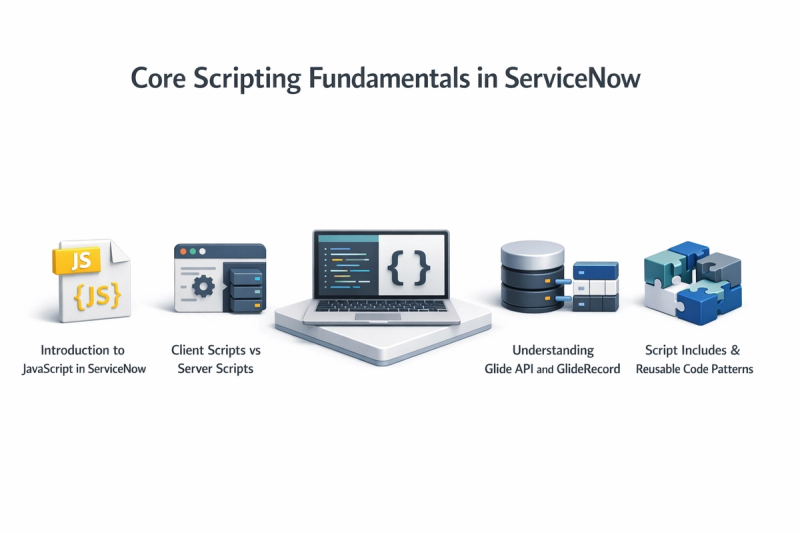
Core scripting fundamentals in ServiceNow form the foundation of all custom development and automation on the platform. ServiceNow primarily uses JavaScript along with its powerful server-side APIs, such as GlideRecord, to interact with database tables and records. Developers use scripting to control data behavior, enforce business logic, and customize how the platform responds to user actions. Key scripting components include Business Rules, Client Scripts, Script Includes, and UI Policies, each serving a specific purpose in managing form behavior, data validation, and backend processing.
Understanding the difference between client-side and server-side scripting is essential for writing efficient and secure ServiceNow code. Client-side scripts run in the user’s browser and are mainly used for form validation and user experience enhancements, while server-side scripts execute on the platform to handle data processing, integrations, and complex logic. By following scripting best practices—such as minimizing client-side logic, optimizing database queries, and using reusable Script Includes—ServiceNow developers can build scalable, high-performance applications that align with enterprise standards and support long-term platform growth.
Business Rules and Server-Side Logic
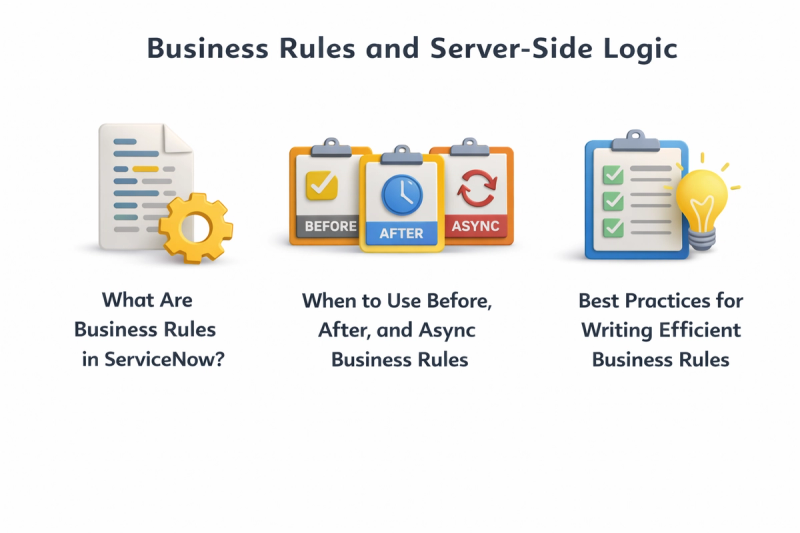
Business Rules and server-side logic in ServiceNow are used to control how data is processed and enforced within the platform’s database. Business Rules run on the server whenever a record is inserted, updated, deleted, or queried, making them essential for maintaining data integrity and applying consistent business logic. They allow developers to automate actions such as updating related records, validating data before it is saved, triggering events, and enforcing organizational policies without relying on user interaction.
Server-side logic ensures that critical processes run securely and efficiently, regardless of how data enters the system—whether through the user interface, integrations, or background jobs. By properly designing Business Rules and leveraging server-side APIs like GlideRecord and GlideSystem, developers can build scalable and reliable applications. Following best practices, such as using conditional logic wisely and avoiding unnecessary execution, helps maintain platform performance while ensuring predictable behavior across environments.
Key points to understand Business Rules effectively:
- Business Rules can run before, after, async, or on display, depending on when the logic needs to execute
- Server-side logic applies consistently across UI actions, imports, and integrations
- Efficient conditions prevent unnecessary rule execution and improve performance
- Business Rules can trigger events, workflows, and flows for further automation
- Proper naming and documentation make server-side logic easier to maintain and debug
Client-Side Development Deep Dive
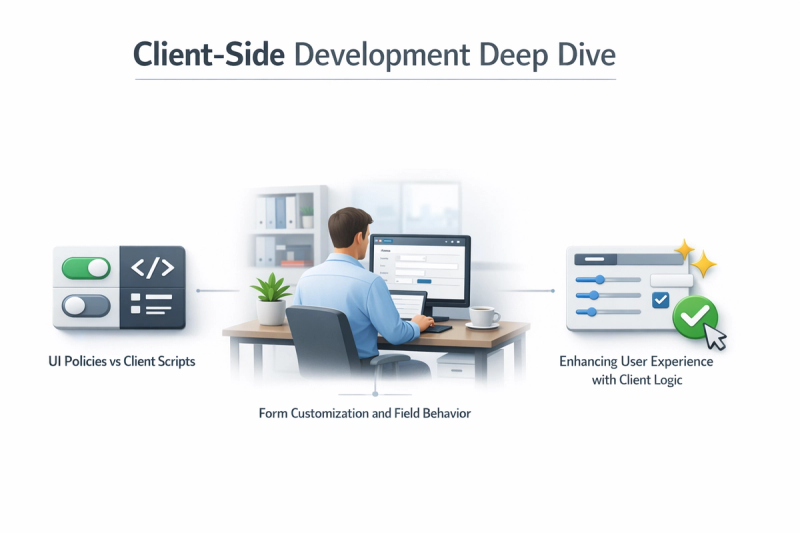
Client-side development in ServiceNow focuses on controlling how users interact with forms and data in real time. It plays a critical role in improving usability, guiding users through processes, and reducing data entry errors before records are submitted to the server. By using client-side tools such as UI Policies and Client Scripts, developers can dynamically show or hide fields, make fields mandatory, set default values, and display helpful messages—creating a more intuitive and responsive user experience without adding server-side overhead.
When comparing UI Policies vs Client Scripts, UI Policies are generally preferred for simple form behavior because they are easier to configure, require little to no scripting, and are more maintainable. They are ideal for tasks like making fields read-only or mandatory based on conditions. Client Scripts, on the other hand, offer greater flexibility and are used when complex logic is required, such as conditional calculations, advanced validations, or interacting with multiple fields. Knowing when to use each approach is key to keeping forms efficient and avoiding unnecessary complexity.
Form customization and field behavior enhancements help streamline user workflows and improve data quality. Client logic can auto-populate fields, validate input values, and provide instant feedback to users through messages or alerts. By thoughtfully implementing client-side logic and minimizing heavy scripts, ServiceNow developers can create fast, user-friendly forms that align with business requirements while maintaining performance and consistency across the platform.
ServiceNow Application Development Lifecycle
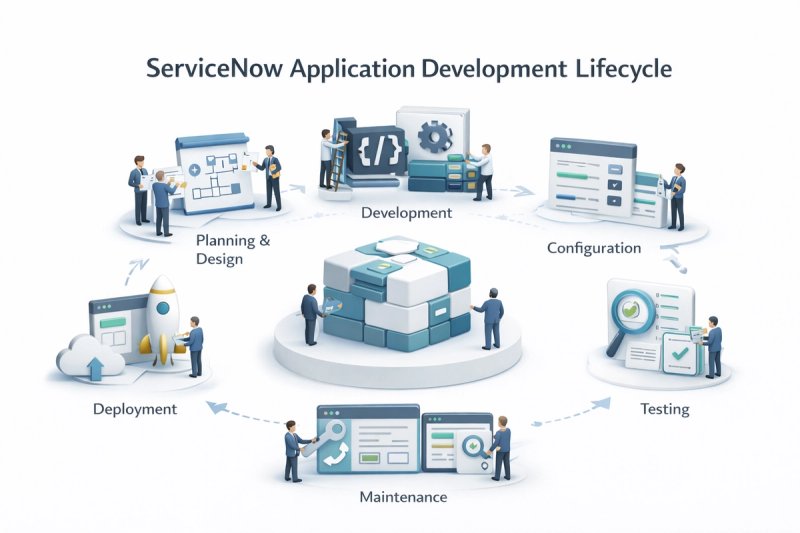
The ServiceNow application development lifecycle is a structured process that helps developers design, build, test, and deploy applications efficiently on the ServiceNow platform. It begins with requirements gathering and planning, where business needs are analyzed and translated into technical designs. During this phase, developers decide whether to create a scoped or global application, define data models, identify integrations, and plan security requirements. A clear design at this stage ensures the application aligns with business goals and reduces rework later.
The next phase focuses on development and configuration, where the actual application is built using ServiceNow Studio. Developers create tables, forms, modules, and business logic using scripts, Business Rules, Client Scripts, and workflows or flows. This stage also includes configuring user roles, access controls, and UI elements to ensure the application is both functional and secure. Since ServiceNow is metadata-driven, most changes are tracked automatically, making it easier to manage versions and promote updates across environments.
The final stage of the lifecycle involves testing, deployment, and maintenance. Developers test the application in sub-production environments to validate functionality, performance, and security before deploying it to production using update sets or application versions. After deployment, ongoing monitoring, enhancements, and bug fixes ensure the application continues to meet evolving business needs. By following this lifecycle, ServiceNow developers can deliver scalable, reliable applications while maintaining platform stability and long-term usability.
ServiceNow Integration Capabilities
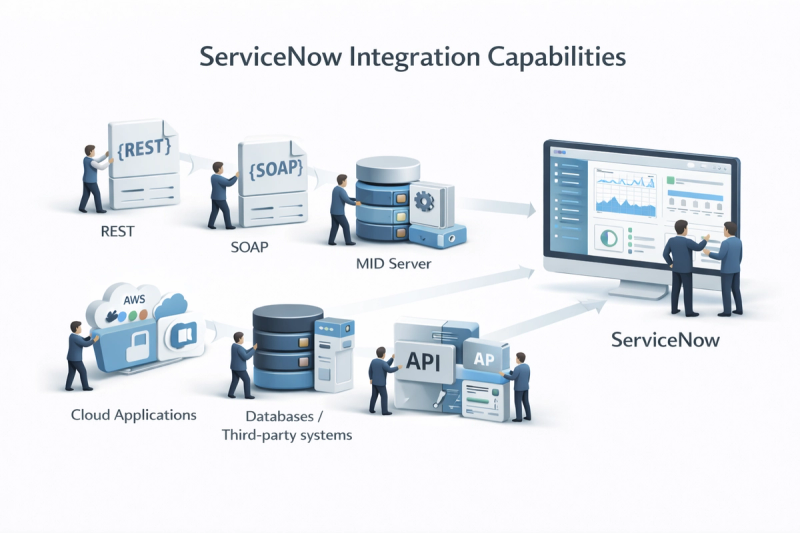
ServiceNow integration capabilities allow the platform to seamlessly connect with external systems, enabling real-time data exchange and end-to-end process automation across the enterprise. ServiceNow supports both inbound and outbound integrations using standard protocols such as REST, SOAP, and MID Server–based connections, making it compatible with a wide range of third-party applications. These integrations help organizations synchronize data, automate workflows, and eliminate manual handoffs between systems like HR platforms, monitoring tools, and cloud services.
A key strength of ServiceNow integrations lies in its IntegrationHub and Flow Designer, which provide low-code and no-code options for building and managing integrations. Developers can use prebuilt spokes, custom actions, and APIs to trigger flows, transform data, and handle errors efficiently. For more complex scenarios, ServiceNow also supports scripted REST APIs, transform maps, and asynchronous processing to ensure performance and reliability. By leveraging these integration capabilities, ServiceNow developers can build scalable, secure, and future-ready solutions that connect ServiceNow with the broader enterprise ecosystem.
ServiceNow Developer Career Path
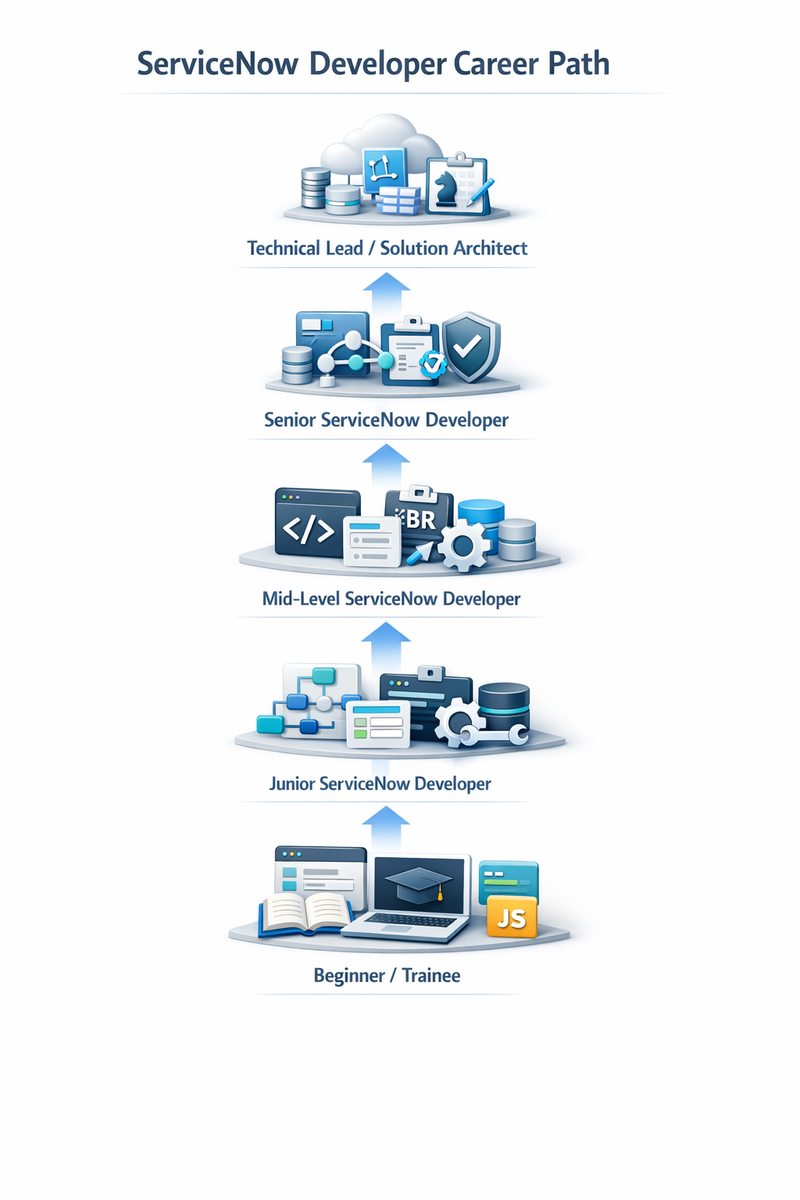
The ServiceNow developer career path offers strong growth opportunities as organizations increasingly adopt the platform to automate workflows and modernize operations. A typical journey begins with learning the ServiceNow platform basics, including tables, forms, scripting fundamentals, and core modules like ITSM. Entry-level roles focus on configuration, basic scripting, and platform support, allowing developers to build a solid understanding of ServiceNow architecture and best practices while gaining hands-on experience in real-world implementations.
As developers gain experience, they move into mid-level and advanced ServiceNow developer roles, where responsibilities expand to building custom applications, writing complex server-side and client-side scripts, and implementing integrations using REST, SOAP, and IntegrationHub. At this stage, developers are expected to optimize performance, enforce security through ACLs and roles, and collaborate closely with architects and stakeholders. Earning certifications such as Certified System Administrator (CSA) and Certified Application Developer (CAD) significantly boosts credibility and career advancement.
With deeper expertise, professionals can progress into senior roles such as ServiceNow Technical Lead, Solution Architect, or Platform Architect. These roles focus on system design, enterprise integrations, governance, and strategic platform decisions. As demand for automation, AI-driven workflows, and digital transformation continues to grow, ServiceNow developers enjoy competitive salaries, global job opportunities, and long-term career stability—making it one of the most rewarding career paths in the enterprise cloud ecosystem.
Future of ServiceNow Development
The future of ServiceNow development is being shaped by rapid advancements in automation, artificial intelligence, and low-code application development. As organizations focus on end-to-end digital workflows, ServiceNow developers will increasingly work with AI-powered features such as predictive intelligence, virtual agents, and intelligent process automation. The platform’s continued investment in Flow Designer, IntegrationHub, and the Now Experience Framework means developers must blend traditional scripting skills with low-code and no-code capabilities to deliver faster, more scalable solutions.
Looking ahead, ServiceNow development will place a stronger emphasis on platform optimization, security, and enterprise integrations. Developers will be expected to build performance-efficient applications that integrate seamlessly with cloud services, SaaS platforms, and emerging technologies. With the rise of AI-driven operations and composable applications, ServiceNow developers who stay current with new releases, certifications, and best practices will remain highly in demand and play a critical role in driving digital transformation across industries.
Conclusion
In conclusion, becoming a ServiceNow Developer today means mastering far more than basic configuration or scripting—it requires a deep understanding of the platform’s architecture, core and advanced scripting, application development lifecycle, integrations, and future-ready capabilities. As ServiceNow continues to evolve into a powerful enterprise workflow and automation platform, developers who build scalable, secure, and high-performance applications will remain in high demand. By continuously upgrading skills, following best practices, and embracing emerging technologies like AI and low-code development, ServiceNow developers can position themselves for long-term career growth and play a pivotal role in driving digital transformation across modern enterprises.