
Manual Testing vs Automation Testing: Which Career is Better in 2026

Manual Testing vs Automation Testing has become one of the most discussed topics among students and IT professionals looking to build a successful software testing career in 2026. Both career paths offer excellent job opportunities, strong salary growth, and high industry demand across the IT sector. While manual testing focuses on understanding software behavior and identifying defects manually, automation testing uses tools and scripts to speed up the testing process. Choosing the right career path depends on your technical skills, career goals, and interest in software testing technologies. As the IT industry continues to adopt Agile, DevOps, and AI-driven technologies, both Manual Testing and Automation Testing are becoming highly valuable career options.
What is Manual Testing?
Manual Testing is a software testing technique where testers manually execute test cases without using automation tools or scripts. In this process, testers interact with the application like a real user to identify bugs, performance issues, usability problems, and functional defects. Manual Testing is often considered the foundation of software testing because it helps testers understand application flow, user behavior, and software functionality in detail. It is one of the best entry points for freshers who want to start a career in the IT industry without strong programming knowledge. In Manual Testing, professionals work on activities such as writing test cases, validating requirements, reporting bugs, performing regression testing, and checking whether the application works according to business expectations. Testers also use bug tracking and project management tools like JIRA, Bugzilla, and TestRail to manage testing activities efficiently. One of the biggest advantages of Manual Testing is that it focuses on the human perspective. A manual tester can easily identify usability issues, unexpected user behavior, and visual defects that automated scripts may sometimes miss. This makes Manual Testing extremely valuable even in modern software development environments.
What is Automation Testing?
Automation Testing is a modern software testing method where automated tools, frameworks, and scripts are used to execute test cases and validate software functionality. Instead of manually checking every feature repeatedly, automation tools perform testing tasks automatically, which helps companies save time, reduce human effort, and improve testing accuracy. In 2026, Automation Testing has become one of the most in-demand skills in the software industry. Companies are continuously releasing updates, new features, and cloud-based applications, which makes manual repetitive testing difficult. Automation Testing solves this problem by enabling faster test execution and continuous testing during software development cycles. Automation testers usually work with tools such as Selenium, Cypress, Playwright, Appium, Jenkins, and TestNG. They also require programming knowledge in languages like Java, Python, or JavaScript to create automation scripts and frameworks. Because of these technical skills, Automation Testing professionals often receive higher salary packages compared to Manual Testers. One of the biggest benefits of Automation Testing is speed and scalability. Automated scripts can execute thousands of test cases within minutes, making it ideal for large applications and continuous integration environments. It also improves test coverage and reduces the chances of human error.
Manual Testing vs Automation Testing: Major Differences
.webp)
Manual Testing vs Automation Testing is one of the most important comparisons in the software testing industry in 2026. Manual Testing focuses on testing applications manually to identify bugs, usability issues, and real-time user experience problems, while Automation Testing uses tools and scripts to perform testing tasks faster and more efficiently. Both testing methods play a crucial role in maintaining software quality and application performance. As companies continue adopting Agile, DevOps, and AI-driven technologies, the demand for both Manual and Automation Testers is growing rapidly. Understanding the differences between these two testing approaches can help freshers and IT professionals choose the right career path in software testing.
Manual Testing vs Automation Testing: Major Differences
In 2026, both Manual Testing and Automation Testing offer excellent job opportunities in the IT industry, but Automation Testing currently has higher demand because companies are focusing on faster software delivery, continuous testing, and AI-driven development processes. Organizations prefer Automation Testers who can work with tools like Selenium, Cypress, and API testing frameworks to improve efficiency and reduce testing time. However, Manual Testing still provides strong opportunities for freshers and beginners because many companies require human-based testing for usability, exploratory testing, and real-user experience validation. Professionals who have knowledge of both Manual and Automation Testing are expected to receive better job opportunities, higher salaries, and faster career growth in the software testing field.
Which Career is Better for Freshers in 2026
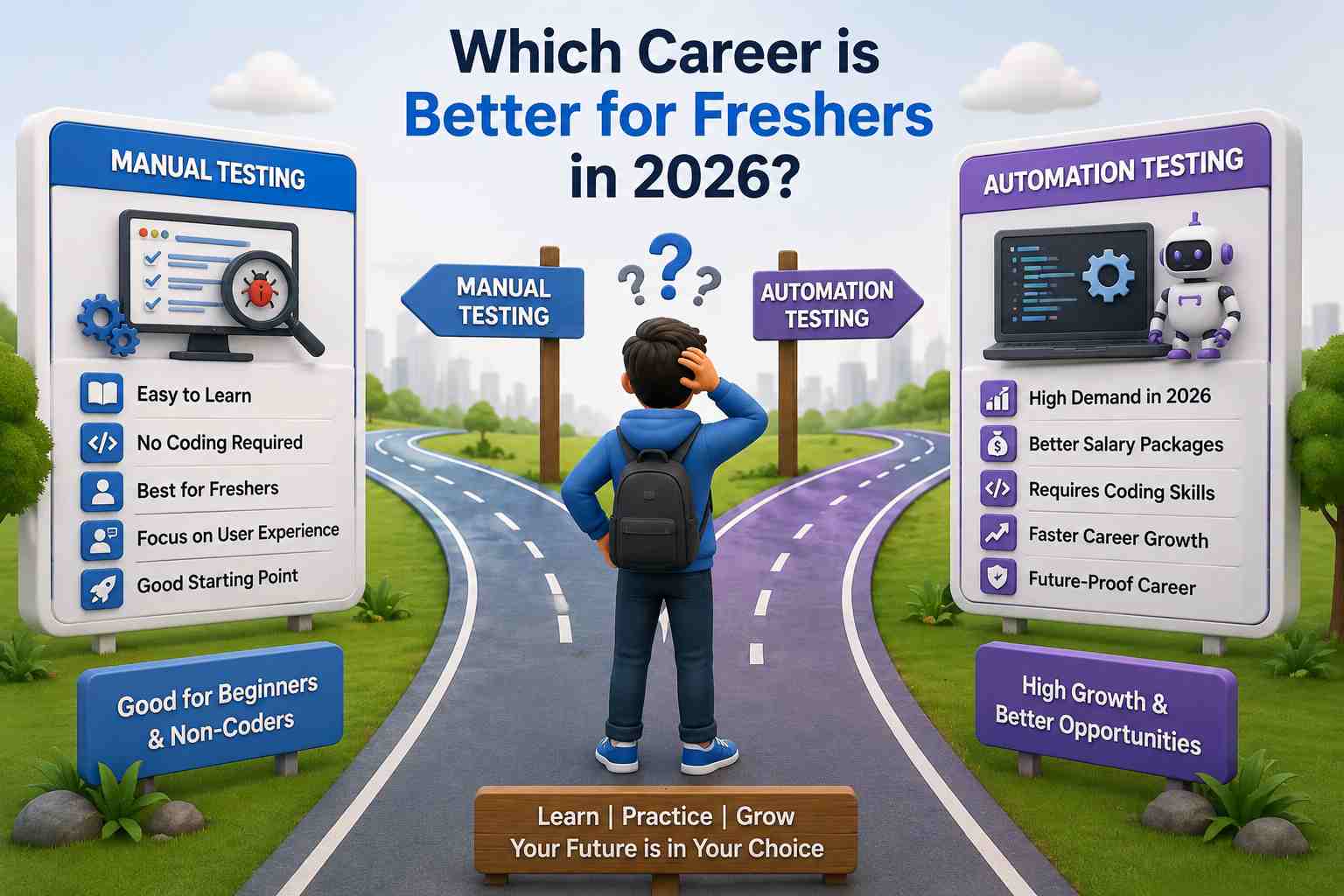
For freshers in 2026, both Manual Testing and Automation Testing offer excellent career opportunities in the software industry. Manual Testing is considered the best starting point for beginners because it helps in understanding software testing concepts without requiring strong coding skills. However, Automation Testing provides better long-term career growth, higher salary packages, and increased job demand due to the growing use of AI, DevOps, and automation tools. The ideal career path for freshers is to begin with Manual Testing fundamentals and gradually move toward Automation Testing to secure better future opportunities and professional growth.
Manual Testing vs Automation Testing: Salary Trends in 2026
In 2026, the software testing industry is expected to offer excellent salary opportunities for both Manual Testing and Automation Testing professionals. As businesses continue investing in software quality, cloud applications, AI-driven technologies, and faster software delivery models, the demand for skilled testing experts is increasing rapidly across the IT sector. However, when it comes to salary growth and long-term earning potential, Automation Testing is currently leading the market because of its strong technical requirements and growing industry demand. Manual Testing remains one of the best entry-level career options for freshers who want to start their journey in the software industry without strong programming knowledge. A beginner in Manual Testing can earn a decent salary package depending on skills, certifications, company size, and project exposure. With experience, Manual Testers can move into senior QA roles, business analysis, test lead positions, and quality assurance management roles, which further improves their salary potential. On the other hand, Automation Testing professionals generally receive higher salary packages because companies highly value automation skills, scripting knowledge, and experience with tools like Selenium, Cypress, Playwright, Appium, Jenkins, and API testing frameworks.
Future Scope of Manual and Automation Testing
The future scope of both Manual Testing and Automation Testing in 2026 is highly promising as the software industry continues to grow rapidly across different sectors such as healthcare, finance, e-commerce, cloud computing, and artificial intelligence. Every company today depends on high-quality software applications, which increases the need for skilled testing professionals who can ensure application performance, security, and user satisfaction. Manual Testing will continue to remain important in the software industry because human observation, usability testing, and exploratory testing cannot be completely replaced by automation tools. Many organizations still require Manual Testers to validate real-time user experiences, identify visual defects, and perform business-oriented testing scenarios. For freshers and non-technical professionals, Manual Testing will remain one of the easiest ways to enter the IT industry and build a strong foundation in software testing. At the same time, Automation Testing is expected to dominate the future of software testing because companies are increasingly adopting Agile, DevOps, AI-driven testing, and continuous integration practices. Businesses now prefer faster software delivery cycles, and automation helps organizations execute thousands of test cases quickly and accurately.
Conclusion
Both Manual Testing and Automation Testing offer excellent career opportunities in 2026, but Automation Testing is becoming more popular due to increasing demand for faster and smarter testing solutions. Manual Testing remains important for usability and human-centric testing, while Automation Testing provides better salary growth, scalability, and future career scope. For freshers, starting with Manual Testing and then upgrading to Automation Testing can be the smartest career strategy. By learning the right tools, programming languages, and testing frameworks, you can build a successful and future-proof software testing career in 2026.
FAQ Section
Is Automation Testing better than Manual Testing in 2026?
Automation Testing offers better salary growth, higher demand, and long-term opportunities, but Manual Testing is still important for usability and exploratory testing.
Can a fresher start with Automation Testing?
Yes, but beginners usually start with Manual Testing fundamentals before learning automation tools like Selenium and Cypress.
Which testing field has higher salary?
Automation Testing generally provides higher salary packages because it requires coding and technical expertise.
Is coding mandatory for Automation Testing?
Yes, basic programming knowledge in Java, Python, or JavaScript is required for most automation testing roles.
Which testing career is best for long-term growth?
Automation Testing has better future scope due to AI, DevOps, and cloud-based testing demand.
Related Articles

How AI is Transforming Software Testing in 2026
AI is transforming software testing in 2026 by automating tests, detecting bugs faster, improving accuracy, and speeding up software delivery.

Software Testing Training for Beginners: Step-by-Step Career Guide
This beginner-friendly guide explains the step-by-step process to start a successful career in software testing. It Covers all Important Topics.